From Scrap Metal to Something New: Luis Carrillo’s Story
For Luis Carrillo, welding is more than a trade — it’s a chance to create something, solve a problem, and take pride in the finished product.
Luis Carrillo likes to build things.
That might sound simple, but spend a few minutes talking with him about his work, and it becomes clear there is far more to it than that.
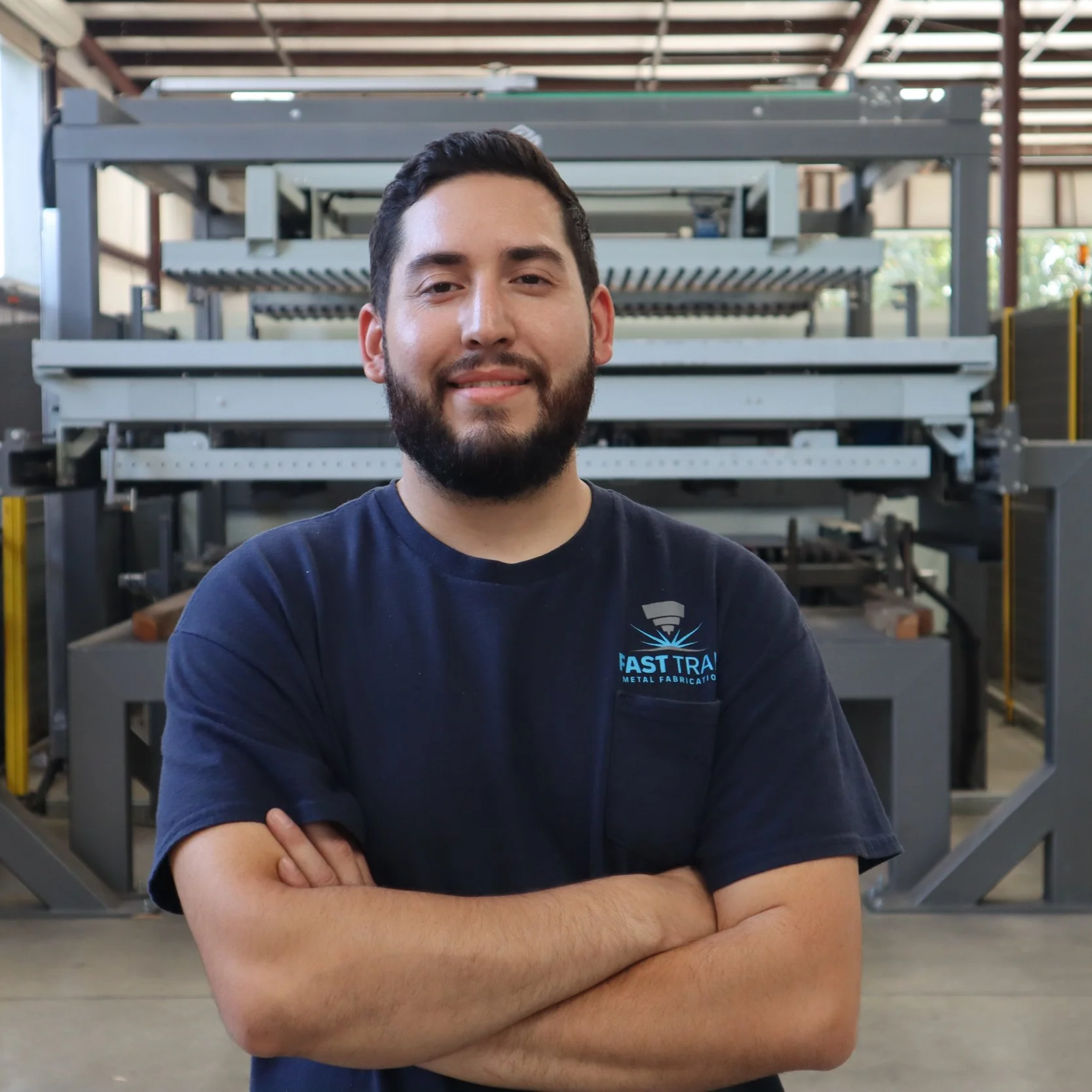
Carrillo is a welder at Fast Trak Metal Fabrication in Fresno, where he has worked for the past five years. His days involve cutting precise metal parts on a laser, welding brackets and components, building tables, or fabricating parts used in agriculture and automotive work.
But what he likes most isn’t necessarily the machinery or even the welding itself. It’s taking something that doesn’t exist and figuring out how to make it.
“I like the aspect of creating something from nothing,” Carrillo said. “I can get a scrap piece of metal, cut it into a shape that I want, weld it together, and I have a table or something.”
That instinct to build is part of what led Carrillo into welding in the first place, although it wasn’t where he started.
When he enrolled at Fresno City College, Carrillo was interested in automotive work. He completed a yearlong collision repair program, but he wasn’t sure he wanted to spend several more years focused on traditional classroom work. So, he tried something different.
He signed up for a welding class. He had never welded before.
“I just ended up liking it,” he said.
One class became another, and then another. Carrillo worked during the day and went to school at night, fitting welding courses around math, English, and other general education requirements. For several years, his schedule was packed, but he kept going.
Eventually, he earned his associate degree in welding, choosing the fabrication side of the program because it gave him another way to work with his hands and connected naturally with his interest in cars.
After graduating, he found his way to Fast Trak.
He started as a laser operator, gaining hands-on experience with the machines and processes used to turn sheets of metal into precise parts. Much of that education happened on the shop floor, alongside people with years of experience.
One of those people was Jose, a longtime employee and foreman who had spent decades working with laser-cutting equipment. Carrillo learned from him by watching, asking questions, and, sometimes, making mistakes.
He learned that a laser doesn’t simply cut the same way every time. Different materials can require different settings. Parts have to be cut in the right order. A small change in speed or heat can affect the quality of the finished edge.
Sometimes, figuring out the problem means trying something new, seeing what happens, and adjusting.
“It’s like your experience to take, and then learn from that mistake,” Carrillo said.
That mindset has become one of the most valuable parts of his job.
Years later, he’s now a welder and knows how to operate all of the major equipment at Fast Trak, moving between departments depending on the daily production needs. He’s taking on more advanced projects and continues to improve his skills.
He still asks questions. He still watches other people work. And now, he’s becoming one of the people others come to when they have questions.
When a new employee joins the shop, Carrillo is happy to help.
“If you have a question, just ask me,” he said. “I’d rather you ask, instead of going out there trying to figure it out, and maybe mess it up or maybe not do it correctly.”
It’s something he learned from the people who trained him. There is a lot to remember in this kind of work, and not every problem has an obvious answer.
Sometimes a job that hasn’t come through the shop for a couple of months requires someone to remember how they handled it the last time. Sometimes the answer comes from trying something new. And sometimes, the fastest way forward is simply asking someone who has seen it before.
Carrillo likes being that person.
He enjoys teaching, something he may have picked up in part from his wife, who is a teacher. He likes explaining his thought process and showing someone else how he approaches a project.
For Carrillo, learning and teaching are part of the same process. That culture is part of what has kept him at Fast Trak Metal Fabrication.
Fast Trak Metal Fabrication is a local, woman-owned business, led by owner and CEO Ferol Garcia. The family-business origin is part of the character of the business, where connection is important within the team and with customers. Experiences are passed from one employee to the next and people are encouraged to learn from one another.
Carrillo says the company gives him room to think through problems and to suggest different ways of doing things, particularly when a new project comes into the shop and there isn’t already a set procedure.
“When we get the first articles that we’ve never done, there’s not a set procedure for it,” he said. “So I have to come up with it.”
That’s one of the things he enjoys most.
The work changes from project to project. Some jobs are straightforward. Others require him to figure out how pieces should fit together or how to weld something without allowing the material to move.
He likes the challenge. He also likes knowing that what he makes doesn’t stay inside the walls of the shop.
Fast Trak works with customers throughout the region, including agricultural businesses that need replacement and wear OEM equipment parts. The business also provides complex assemblies and finished products for a variety of industries throughout the state.
Carrillo sometimes sees the results around Fresno. He might be driving through town and recognize a sign or a part that he helped make.
“Hey, I made that sign right there,” he said.
There is something satisfying about that.
The work happening inside a fabrication shop can seem removed from everyday life. A bracket, replacement part, or fabricated component might not look particularly important on its own, but that part eventually goes somewhere.
It becomes something another person uses to do their job. It helps keep equipment running. It becomes a part of a business, a vehicle, or a piece of agricultural equipment.
“I’m making something for someone else to do their job more efficiently,” Carrillo said. “I’m giving them the tools to do it.”
For Carrillo, that’s part of what makes the work meaningful.
The person cutting or welding a part in Fresno may never meet the person who eventually depends on it, but the connection remains. The work moves from the shop to the farm, the business, the vehicle, or the street. And in a place like Fresno, where so much of the economy depends on people and businesses being able to make, move, repair, and build things, those connections add up.
Carrillo has found a career in the middle of that network. Five years in, he still wants to get better. He hopes that after nearly a decade in the trade, he’ll be able to look at almost any welding project that comes through the shop and know exactly how to approach it.
There’s always more to learn, he says.
His advice to someone considering the trade is straightforward: take care of yourself, stay open-minded, be willing to learn different ways of doing things, and take pride in what you make.
“Metal work is like an art form,” Carrillo said, “you should take pride in the finished results, producing something that’s quality.”
For someone who didn’t start out knowing exactly what he wanted to do, Carrillo has found something that fits him. He gets to work with his hands. He gets to solve problems. He gets to learn from people who know more than he does, and then pass that knowledge on to someone else.
Most of all, he gets to build things, and every once in a while, when he’s driving around Fresno, he gets to see something he helped make.
That might sound simple, but for Luis Carrillo, it means quite a bit.