Finding a Future in Fresno Manufacturing
When college plans shifted during COVID, George Cummings discovered a new path in machining.
George Cummings did not grow up imagining himself inside a machine shop. He grew up in Coarsegold, California, a small mountain town about 15 minutes south of Yosemite. For years, his world revolved around restaurants and college coursework — not steel, calipers, or CNC machines. “I work at PNM Co., and I am a machinist,” he said now, almost casually, as if it were always the obvious destination.
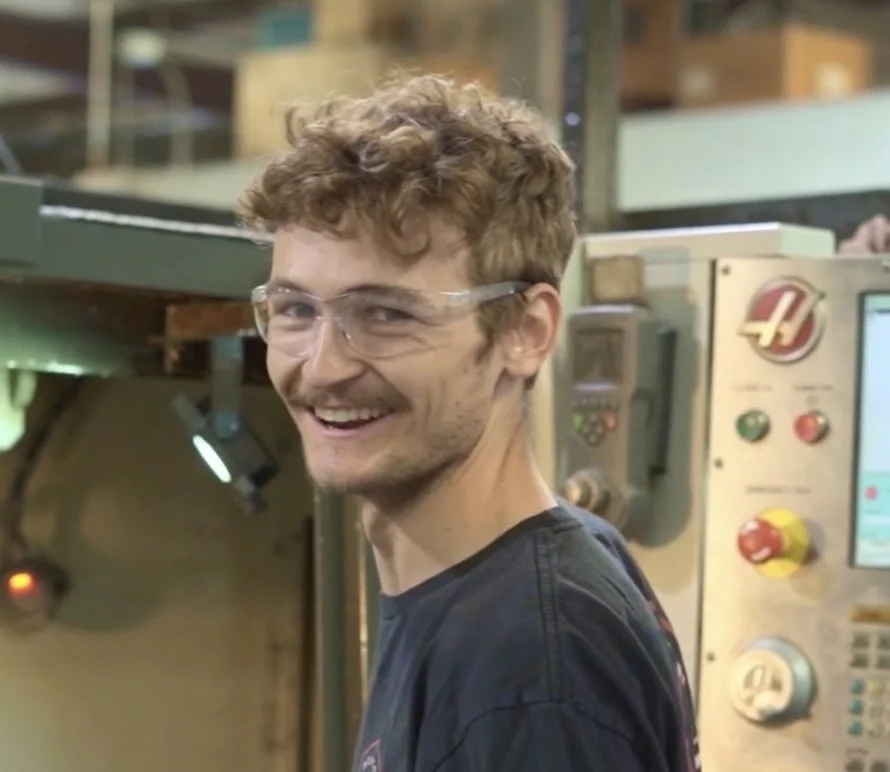
It was not.
Cummings put himself through California State University, Fresno as an exercise science major, planning to go into physical therapy. He worked as a server from the time he was 18, moving plates and drinks across dining rooms, thinking in terms of anatomy and physiology. Then COVID arrived, and like many people his age, his carefully laid plans began to loosen. “After COVID hit, I was just like, three or more years of school just did not sound that fun.”
During that same period, he bought a 3D printer. It was meant to be a hobby, something creative to fill the long, quiet days. Instead, it opened a door. “As soon as I bought it, I’m like, how the heck do I use this thing?” Learning how to make the printer work led him into software, design, and manufacturing concepts he had never seen before. He taught himself SolidWorks and computer-aided design (CAD) programs, slowly realizing that manufacturing was not just about machines, but about translating ideas into physical reality.
The turning point came in an unlikely place. While serving at a tiki bar and grill at Bass Lake, wearing a Hawaiian shirt and pouring drinks for tourists, he befriended a regular and his son. A year later, he learned the man owned Clancy Machine Tool Incorporated, one of the largest tooling companies in the state. “I didn’t even know what he did,” Cummings said. When he found out, the pieces connected. He asked for advice. The answer was simple. Call PNM.
He did. He asked if he could shadow or intern. He was told he could not hang around uninsured, but he was invited to come talk. Months later, he was brought in through an internship program on a 200-hour trial. “Once you get through those 200 hours, we’ll see if we want to keep you on or not.” They kept him.
Cummings started at the bottom, running machines and learning how to measure parts, read drawings, and handle tools. “You gotta start at the bottom just to get the basics, the fundamentals of everything.” He was honest about it. The work did not thrill him, but he knew it was necessary. So he learned fast and asked questions constantly.
“I bring down the average age of the shop by about 20 years,” he said. Around him were decades of experience. He leaned into it. “There’s a plethora of knowledge for me to go to.” Mario, the shop leader, the lead programmer, the quality assurance director, and others became daily teachers.
He carried a notebook everywhere. “I have a little notebook on me that I have had since the beginning,” he said. “It’s in big Sharpie, it’s called the Shop Bible.” Every day, he added something new. Measurements, processes, lessons learned. It became his personal archive of progress.
Three or four months in, he was promoted from operator to setup. Instead of running thousands of identical parts, he began preparing machines for entirely new jobs. Breaking down old setups, installing new tools, touching off measurements, producing the first perfect part before handing the machine off to an operator. It was the point where responsibility and trust intersected.
PNM is a job shop, meaning variety defines the work. One day, it might be parts for wheelchairs, the next, watersport accessories. The next, hardware for boats.
“Anything you can think of, they send us a 3D model of what they need made.” That constant change is what keeps him engaged. “You’re not just pushing out the same part. Everything’s different. I have no idea what I’m walking into on a Monday morning.”
For Cummings, that uncertainty is not stress. It is fuel.
The machine shop has also reshaped how he thinks about education and work. “For machining in particular, there’s no requirements,” he said. “If you’ve got it, then great.” Certificates exist, and they matter, but experience matters more. Time behind machines. Time understanding what software commands actually do in steel and aluminum. “It’s the thinking behind the software,” he said, “and having the time behind a machine.”
When people dismiss industrial jobs as “bad jobs,” Cummings is direct. “It’s only a bad job if you let it.” He sees people who have spent decades in the shop and others who treat it as a stepping stone. For him, it is neither a dead end nor just a paycheck. It is a foundation. “I want to learn everything,” he said. “I want to own my own machine at some point and figure out how this all works.”
He already applies the mindset outside of work. While serving on weekends, he sees inefficiencies and imagines products that could solve them. “I could probably make a product that could roll silverware for somebody.” Now, those ideas are not just thoughts. They are designs he can model, prototype, and eventually manufacture himself.
He has already begun doing side projects, machining small parts, and experimenting with programming. “I’ve made wheel spacers for my uncle’s truck,” he said. It is not about side income. It is about proving to himself that he can build something real.
What makes Cummings especially valuable to his shop is not just what he knows, but how he learns. “I won’t let anything really get past me if I don’t understand it.” That persistence is now turning outward as younger or newer workers come in behind him. Teaching, he admitted, is harder than learning. “I have to figure out how to tell it in different ways.” He jokes that he might need a second notebook just for training.
Born in 2001, Cummings embraces his Gen Z perspective. “You have to let the kids play.” To him, that means giving young workers access to real responsibility and real knowledge, not gatekeeping. “You’ve got to invest in them like you’re buying a new machine.”
And to the employees themselves, his advice is simple. Do not get complacent. “You have to always be learning.”
In a time when industrial work is often misunderstood, Cummings represents something deeply practical and deeply hopeful. These jobs are not abstractions. They are places where skill is built, responsibility is earned, and creativity takes a physical form. They stabilize local economies. They preserve institutional knowledge. They give young people a way to turn curiosity into competence.
“I’m learning how to design stuff and how to make assemblies work together,” he said. “Now I’m holding it in my hand out of the machine.”
For George Cummings, that moment, the transformation of idea into object, is not just work. It is proof that making things still matters.